The science of timing
Jyotish is about time: the time of birth, the time of death, the day of the week, hour of the day, the periods in which a certain Graha (planet) is occupying a certain Rāśi (sign), etc. are all elements that help us to measure correctly not only the time, but most importantly: its quality.
By "quality" we mean the energy that is present at a certain time, and if it's supporting our endeavor, since the moment when we start something dictates its results.
Muhurta
The branch of jyotish that studies the most auspicious moment for a beginning (or ending) is called Muhurta.
As it was mentioned, the way and most importantly the time at which we begin something is what will give the results. With this in mind, it would be logical to find a moment in which the energy is sustaining what we are starting.
Marriages, business launches, property purchases and traveling are some of the ventures we may encounter throughout our lives and that, with the knowledge of muhurta, we can attempt to ensure a smooth result.
"the way and most importantly the time at which we begin something is what will give the results"
So, what exactly would we need for a smooth result?
Jyotish is a complex science, there are many factors to take into consideration and it can be hard to find the perfect muhurta for an endeavor. However, there are some basics we can take into consideration to choose a proper muhurta.
Let's look into them through the lens of a recent experience: a trip to Guatemala.
(The following principles were taught by my Guru Branka Larsen in her book "Letters to my jyotish friends".)
This is the chart of the Muhurta we picked for our trip (you can see it with more details here). It is definitely not a perfect muhurta, but it was good enough.
Let's look at the muhurta principles that were fulfilled — aka what made it good enough:
- The Naisargika karaka (natural significator) of the activity needs to be well placed in the chart. Performing the activity on the day of the karaka strengthens it. Karaka shouldn't be Vakri (retrograde) nor ashtangata (combust).
For our trip, we ensured to travel on a Friday (Sukra day), with Sukra (Venus — karaka of traveling) in Lagna (ascendant); it was also during Venus hora. (It is worth noticing that Mesa–Aries isn't the best placement for Venus.)
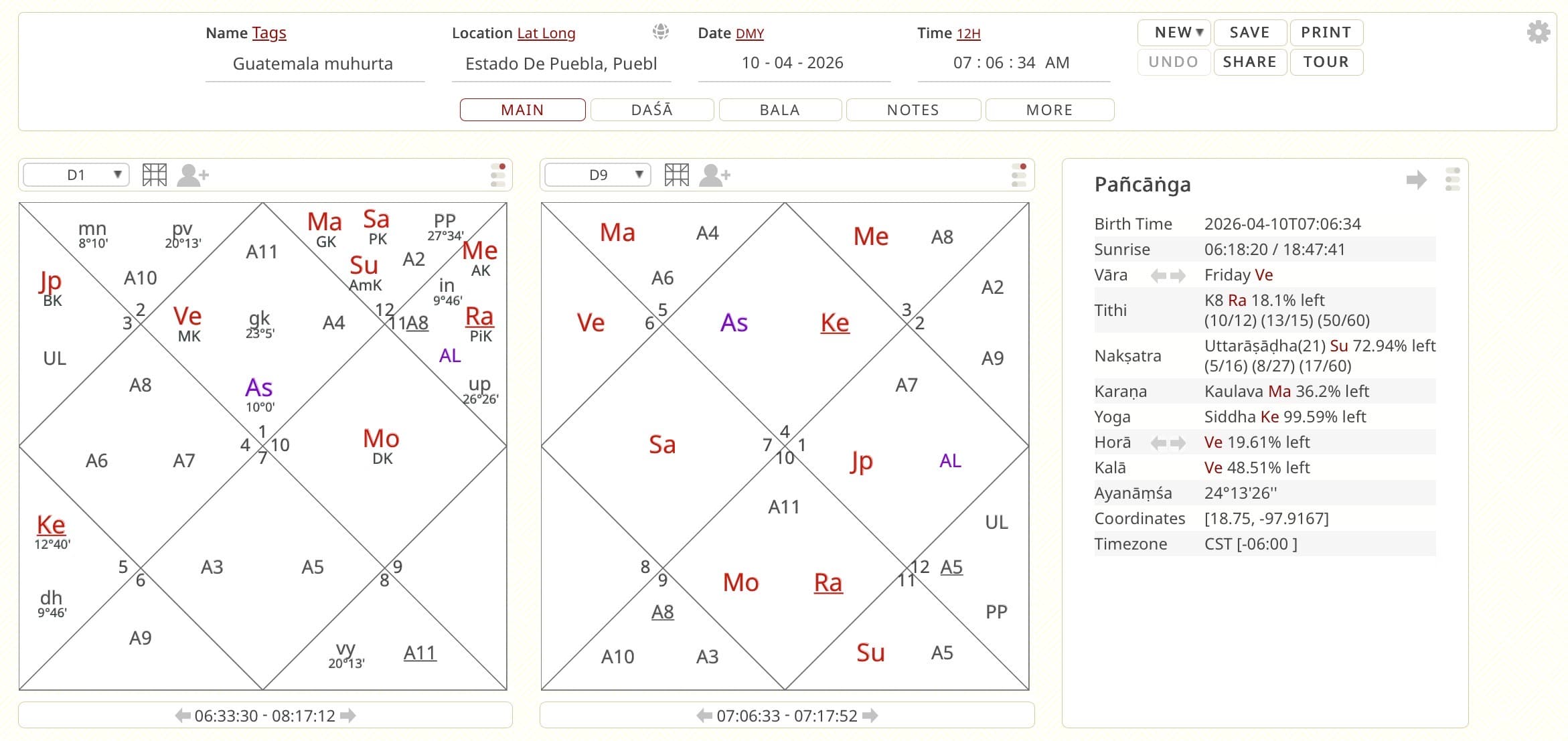
- 8th house should be empty: this house shows the reasons why a trip may end up prematurely or can be shortened. Moon here is particularly forbidden, since it is Marana karaka sthana position for it and can indicate death-like experiences and danger to one's life during the trip.
- 7th house must also be empty; grahas here could cause delays related to their significations.
- Moon ideally should also be alone — if it's conjoined with any other grahas, it will color our experience and thoughts during the trip.
- As a general rule, we must avoid having any grahas in marana karaka sthana position in D9 — Navamsa.
- Panchanga yoga is an important aspect of choosing a muhurta, since it is the akash energy and what is holding the chart together; we chose siddha yoga because it is an auspicious one.
Flaws of this muhurta:
- The muhurta activates when you leave the home to start the travel. In this case, for us to ensure having Sukra in lagna, we departed somewhere between 7:06 and 7:17 AM; our flight departed at 19:00, so we had to leave home twelve hours before the flight.
This is not a flaw in itself, but it was a bit tiring.
- Grahas in the fourth house — or, if it's empty, its lord — will determine the comfort during the trip.
In our muhurta, Chandra (the moon) was ruling the 4th house and was placed in the 10th house, landing in a position known as Drg Hiina (zero directional strength). And yes, during our trip we never lacked food and our accommodations were clean and in good areas of the city (since the lord is the moon itself and it was in a kendra). But we faced a couple of strange situations: one day we ended up eating enfrijoladas on the bus because we didn't have time to eat before; in one hostel the mattress had more usage in the center and the breakfast pancakes were a bit raw; in another accommodation the mosquitoes bit us all night; and the last place we stayed in was a modified house without too much privacy.
Also, it is worth noticing that Chandra is in the 10th house, so during the trip our mind was on our work.
- In this chart, the lord of the 9th house is in Marana karaka sthana.
This was my main concern: the lord of the house of fortune and long-distance travel feels like it is dying in the 3rd house, and it is also being aspected by Rahu and Mars. We experienced this when we were entering back into Mexico and were held by the immigration officers, rushed to provide certain documents (Mangal + Rahu). This was the most tense part of our trip.
We balanced this out with the Bhava Chalit to change our perception of the trip.
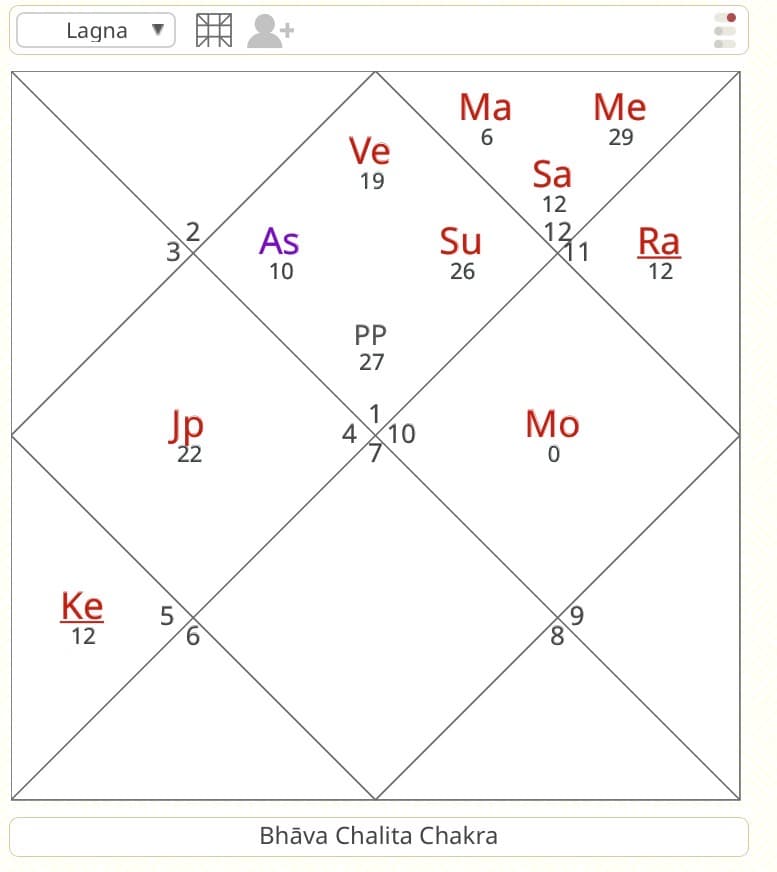
(The Bhava Chalit Chakra is a chart in Jyotish that reflects where planets actually fall in terms of house experience, as opposed to the sign they occupy in the main chart, offering another reading of how a planet's energy is lived out.)
This Bhava Chalit shows a Guru (Jupiter) exalted in the 4th house. This was also present during the trip: our feelings around the difficulties weren't too intense and were resolved easily, and we had the contrasting experience of some beautiful accommodations and some REALLY good food.
It also brings the sun out of its marana karaka sthana to Aries lagna, its exaltation Rashi. This manifested as some painful sunburns after kayaking for two mornings.
- Tithi (Krishna ashtami) is not auspicious for traveling; its energy is usually recommended for defense or arguments.
- 12th house has the ruler of the Naksatra Surya (sun) in marana karaka sthana alongside the combination of Shani (Saturn) and Mangal (Mars). Shani was ashtangata, but they weren't in yuda (war).
This Yama yoga in the 12th bhava (house of the foreign land) was also a concern, but the conjunction was going to last for a while and we didn't have that much wiggle room for choosing a different date.
Other experiences worth mentioning that we can see from the chart:
I would like to highlight the Chandra + Rahu conjunction in navamsa — the "shock" factor was there for us at the end of the trip when we hiked the Fuego volcano. It was shocking in a physical way (Chandra is lagna lord of D9) due to the huge amount of effort and time it took, and the sight of an active volcano erupting while we were above the clouds.
Choosing a muhurta for this trip helped us ensure a safe trip and to be prepared for some situations that we knew had the possibility of arising. It was a good practice of expectation vs reality, and it highlighted the importance of finding the best time we can for certain activities.
Finding a proper muhurta requires both patience for the right timing and compromise. It isn't about finding perfection — it's about working with time consciously, knowing what you're walking into, and preparing accordingly.
The more significant the endeavor, the more it's worth taking the time to find a good moment. Marriages, business launches, a trip that means something to you… these are worth the patience and the compromise that muhurta requires.
Curious how to find an auspicious moment for an upcoming venture of your own? Book a Muhurta consultation to choose a date that supports what you're starting.